Travel Agency Software: Booking System & Mid/Back-Office Solution
2 decades in travel technology teach you a few hard truths. Some are comforting. Some are brutal. For Ranga Prasad, founder at Iween, one learning has stood the test of time. He says,
No matter how sleek your brand campaigns look, how many certificates decorate your office wall, or how many investors you parade at your annual gala, your travel agency stands or falls on the strength of its software stack.
That’s right. Your booking platform, your agency management layer, and your mid and back-office engines are the cardiovascular system for your travel agency. If you’ve invested in the right travel technology, it can help you survive even the worst economy, even when you’re snarled up in uncertainties. But if stacked wrong, it can derail your growth even in the most favorable economic wave.
Ranga added, “I speak from Iween’s vantage point, with scars from economic downturns and victories in boom cycles, across the US, Europe, Asia, and the Middle East. I have seen TMCs wrestle with fragmented content, legacy debt, regulatory headaches, and the endless hype of AI is coming to save us.” He continued, “Some truths are universal. You need a booking core that doesn’t collapse under scale, an agency management system that doesn’t make you want to pull your hair out, and a mid/back-office that actually reconciles what you book with what you bill.” Sounds simple? It never is. Let’s break down what’s needed in a modern travel agency software stack.
The Booking Stack: More than just Search and Ticketing
Booking is deceptively glamorous. It is the moment your traveler's dreams turn into an itinerary. But seldom do the agency leaders have any insight into how fragile their booking machinery is. The booking stack is where agencies live or die because it is both the frontline of customer experience and the foundation of operational integrity.
- Infinite inventory, without infinite overheads
What does your stack need to do? Aggregate content. Airlines, hotels, LCCs, NDC offers, GDS feeds, rail, buses, tours, ancillaries, and insurance. The list never ends. And customers don’t really care where it comes from. They expect you to serve it in milliseconds, at the right price, with availability intact. Miss by a second, misprice by a cent, or misfire about availability, and you are dealing with disgruntled customers. Is your booking software ready for that kind of zero-tolerance game?
Product Shoutout: For travel agencies and OTAs struggling with fragmented supplier integrations, Iween API gateway is a unified single API to connect and access inventory from 160+ suppliers while reducing time-to-market and costs by up to 90%.
- More booking engines, more issues
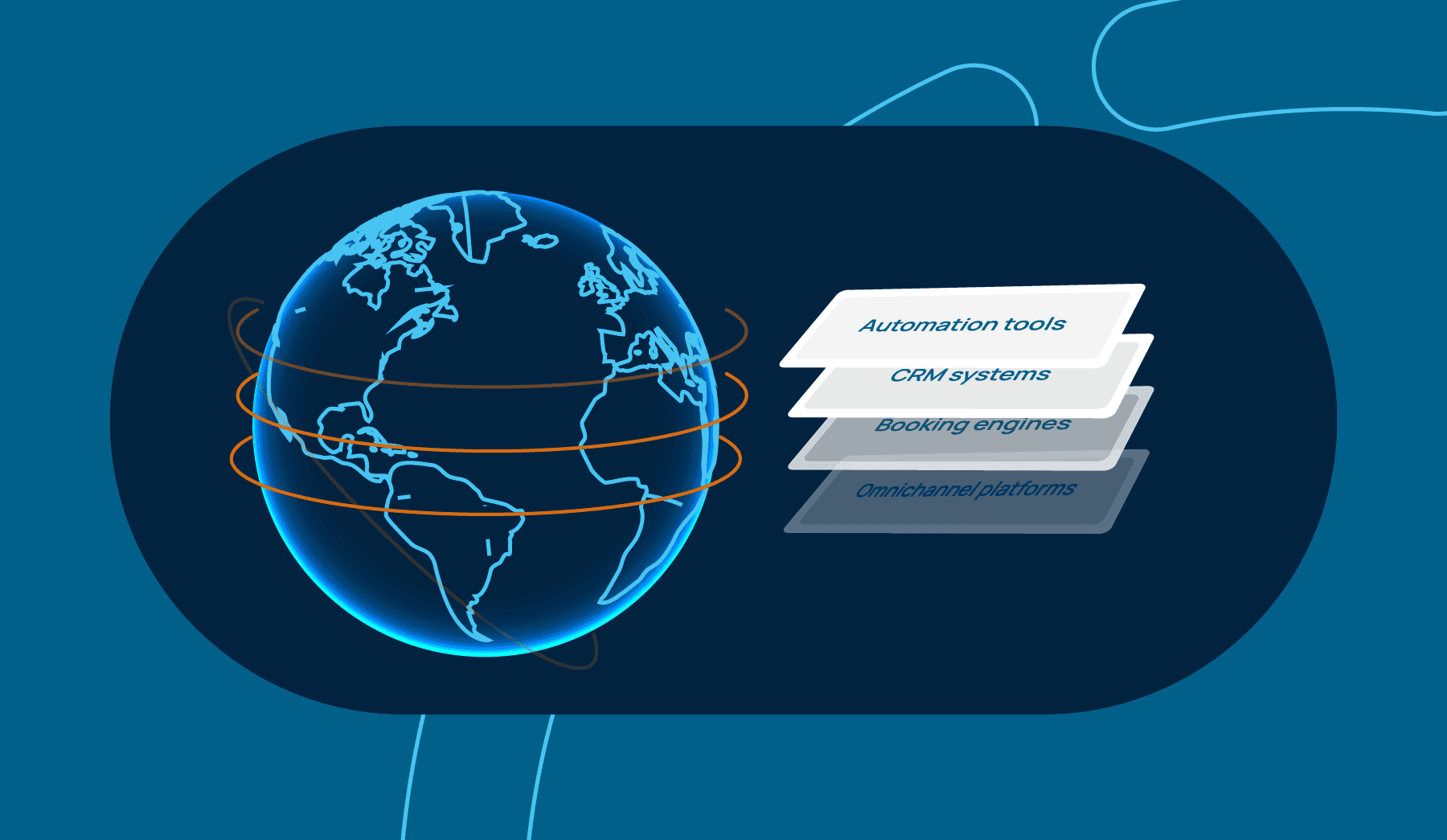
Most agencies today are juggling multiple booking engines, some as many as 7, stitched together with duct tape. One system for air, another for hotels, another for rail, a loosely integrated third-party plug-in for insurance, and whatnot. Agents are trained across 5 different interfaces, which adds to overhead and inefficiencies. Do you know what this does to agent morale? Or to customer patience? Well, to say the least, neither fares well.
This is where technology has both promised too much and delivered too little. AI search? Predictive pricing? NDC disruption? All valid. But what is the ground reality? Your booking engine must integrate legacy GDS feeds with new distribution channels, reconcile multiple fare families, manage markups, and comply with each market’s tax regimes. None of it is glittery, glamorous work that wins accolades, but these are mission-critical to keep your travel business running. Fail here, and your “customer experience” slides down the drain in seconds. Your revenue follows it.
- Intuitive UI and agent booking experience are non-negotiable attributes for travel agency software
Training agents to use legacy travel software is a herculean task. Every new distribution channel, every new fare filing standard, every shift in IATA regulations means retraining your staff. But agents are pressed for time, already dealing with frustrated travelers, delayed refunds, and overbooked flights. They don’t have the bandwidth to learn clunky new systems now and then.
If your travel agency booking software is not intuitive, if it takes 10 clicks to perform a task that should take 2, you’re burning both productivity and morale. Do you really want to bleed talent or revenue because your software is stuck in the dot-com era?
- Your booking engine should absorb the pressure
For a travel agency, the pressure is multi-fold: speed, accuracy, and experience. Scalability, too. Can your booking system handle seasonal surges, sudden group bookings, or corporate clients requesting a hundred PNRs at once? If your answer is maybe, then you already know the risk you’re carrying. Because in business and travel, a ‘maybe’ could often be a missed opportunity.
- Keeping travel clients delighted is a complex maze to crack, and it demands continuous hustle
Whether it’s a global corporation with a strict SLA or a honeymoon couple who will remember your brand for life, the margin for error is zero. Advanced booking management software must track preference history, negotiated fares, duty of care, visa requirements, and even traveler wellness. Miss one detail, and you lose the account. Agencies know this. That’s why the pressure to digitize is relentless.
Mid and Back-Office: The Invisible Spine
Once you’ve booked, the next mountain is managing the agency itself. This is where travel agencies often underestimate the complexity. You’re not just running one booking desk. You’re running a multi-branch, multi-geography, multi-stakeholder operation with agents, sub-agents, corporate clients, leisure customers, regulators, accreditation bodies, and suppliers pulling you in every direction. One slip, and you’re chasing refunds across continents or losing corporate accounts because an SLA was breached.
To solve this part of the puzzle, you need a robust mid and back-office travel software. If booking is the heart, and agency management is the brain, then the mid/back-office is the spine of your travel company. You may not notice it when it’s healthy, but the moment it fails, your entire operation collapses.
- The mid-office software automates the boring to establish order in chaos
It ensures that every booking is validated, rules are applied, documents are generated, and workflows are triggered. It’s where fare rules are checked, visas are flagged, quality control scripts are run, and fraud detection is applied. Without a strong mid-office, you’re relying on agents to manually catch errors. And manual processes in travel are like open invitations for disaster. Why? Because you are operating in milliseconds, across multiple suppliers, currencies, and time zones. Humans simply cannot keep up unless they are sloth-slow, which limits their agency growth.
From CRM to agent performance analysis, from lead distribution to workflow automation and compliance reporting, the mid/back-office travel software has to carry everything. Do you realize how heavy that load is? And yet, most agencies run these functions on outdated ERP-like tools or, worse, Excel sheets duct-taped with WhatsApp groups. That’s not management. That’s, I don't know, ‘firefighting?’
- The back office is where the money gets real
Reconciliation, invoicing, supplier payments, commissions, BSP/ARC settlements, refunds, and credit notes. Every number must line up. Agencies bleed millions every year because their back office doesn’t reconcile bookings with invoices. Errors compound, disputes escalate, and cash flow suffers. And in this economy, with margins thinner than airline seat cushions, cash flow is king. Do you want to play dice with it?
Unfortunately, many agencies treat the back office as an afterthought. They invest in flashy booking engines and CRM tools, but their accounting systems run on outdated platforms that were never designed for modern travel. They cannot handle multi-currency, multi-GDS, NDC fare structures, or even the volume of transactions. The result? Agents spend hours reconciling reports manually. Refunds take weeks. Clients lose trust. And agencies wonder why retention is falling. The answer often lies in the back office.
- Travel agency software must facilitate seamless multi-branch management without any juggling
Agencies today rarely operate in one city. They’re spread across geographies, sometimes across countries. Different markets mean different regulations, different tax structures, and different supplier relationships. Your agency management system has to consolidate all of this into a single source of truth. One dashboard that actually shows what’s happening in Dubai, London, and New York without making you cross-check 3 reports and 10 email chains. Yet how many systems really do this well? Very few.
The Agency’s Crossroads: Pressure, Aspiration, and Reality
So, where does this leave us? Agencies today are under crushing pressure. You can’t call ‘tech’ a dependency anymore; it is the way of doing travel business. Digitization is existential. Besides, training costs are rising, accreditation requirements are strict, and clients are unforgiving. To add to the challenges, the competitive field is cutthroat, with OTAs slashing prices, airlines pushing direct NDC, and fintech players eyeing to eat travel payment margins.
Yet, aspirations remain high. Agencies want technology that works seamlessly. They want software that empowers agents, delights customers, and simplifies compliance. They want platforms that can scale across geographies, unify operations, and integrate new distribution channels without breaking everything else. They want the holy grail: one stack that does it all, without costing a fortune or requiring endless training. Is it too much to ask? Perhaps. But it’s what the market demands.
At Iween, we see this crossroads every day. We see the fear in agencies worried about survival. We see the ambition in agencies dreaming of scaling globally. And we see the reality, those who don’t deviate from the hype and invest in the fundamentals are the ones who thrive. The online booking stack and the mid/back-office software are critical. Get these pillars right, and you can weather economic downturns, navigate regulatory storms, and ride growth waves.
Closing Thoughts: The Road To Take
Travel technology has always been a field of potent promises. Every year, a new buzzword enters the scene: AI, blockchain, NDC, personalization, super-apps. And yes, they all matter. But strip away the noise, and the fundamentals don’t change. A travel agency is only as strong as its software spine – booking. management and mid/back-office.
So, I’ll leave you with a question: is your agency building on rock or on sand? Because in the travel industry, the storms are constant. The only agencies that survive are those whose software stack can withstand them during challenging times.

Nishant Choudhary
Content MarketerIn this article
1.The Booking Stack: More than just Search and Ticketing
2.Mid and Back-Office: The Invisible Spine
3.The Agency’s Crossroads: Pressure, Aspiration, and Reality
4.Closing Thoughts: The Road To Take