
How to Get IATA Accreditation for Your Travel Agency?
Running a travel agency in today's climate is not for the faint-hearted. Between wafer-thin margins, constant supplier negotiations, and the inevitable pressure of automation, one decision looms large for your agency, if you want to play in the big leagues: whether to pursue IATA accreditation. If yes, how?
For many, that little numeric code feels like the holy grail. For others, it looks like a bureaucratic headache wrapped in red tape. The truth, as always, is somewhere in between.
At Iween, we've walked alongside travel agencies of every size; the nimble storefront that still thrives on community relationships, the mid-sized OTA pushing dynamic packages, and the global TMC wrestling with compliance at scale. We've seen what happens when agencies chase IATA accreditation with a clear business case, and we've also seen the wreckage when they do it blindly. Read this blog as we share what it’d really take for you to get IATA certified, and why you may or may not want it.
What’s IATA Accreditation?
Think of it as a license.
IATA accreditation is an official recognition by the International Air Transport Association (IATA) that allows a travel agency to sell and issue airline tickets directly on behalf of airlines through IATA’s Billing and Settlement Plan (BSP).
Without it, most agencies can’t deal with airlines directly. They have to go through intermediaries like consolidators or host agencies. With it, your agency gets its own verifiable IATA numeric code, ticketing authority, and the ability to settle transactions directly with airlines.
To IATA and airlines, accreditation is a trust mechanism. They’re essentially saying, “We trust you enough to let you handle money on our behalf.” But that trust comes with strings attached: financial guarantees, audits, compliance, and reporting.
Why IATA Accreditation Even Matters
You might wonder, “Why does IATA accreditation still command so much mindshare in 2025?” After all, with NDC direct connects, airline APIs, and aggregators opening up inventory access, some argue that IATA's BSP framework is a relic of the 90s. And yet, many agencies still chase that accreditation. Why?
Because IATA accreditation equals direct ticketing authority. It signals to airlines that you are a vetted, financially solid, and professionally compliant travel agency. It allows you to issue tickets directly through BSP or ARC in the US. It gives you leverage in supplier negotiations, credibility with corporate buyers, and operational independence. If you're chasing larger enterprise clients, especially multinationals, IATA accreditation isn't just a badge of honor; it's often a prerequisite.
But some agencies get IATA-certified only to realize they've locked themselves into a complex compliance regime, stringent financial guarantees, and operational overhead that dwarfs the value of the accreditation. Sometimes, it is not that needed for a TA operational at a small scale, as alternative models or via mediums like consolidators or host agencies already cover their needs.
So, before you even touch the paperwork to apply for the IATA accreditation, you need to ask yourself: Do you really need this? Or do you want it because everyone else in the industry told you it's the right thing to do? The question isn't just “Can I get IATA accreditation?” but “Should I?” That's where most agencies stumble. Let's unpack what's really at stake.
Accreditation Business Case
When you apply for IATA accreditation, you are not just buying access to BSP. You are committing to maintain a level of financial solvency, risk management, and compliance oversight that will be audited regularly. For small and mid-sized travel agencies, that translates into tying up cash in bank guarantees, letters of credit, or insurance bonds. That money is not fueling your marketing or your tech stack; it's sitting idle to reassure airlines you won't default.
You also need to maintain accounting systems that sync seamlessly with BSP reporting cycles. Miss a payment or misreport sales, and you risk being suspended or even blacklisted. Operational discipline isn't optional. It's mandatory.
Now let's look at the flip side. If you handle large volumes, especially corporate air travel, direct accreditation can
- Save you substantial consolidator fees
- Give you more control over fare filing, ticketing, and refunds
- Improve your bargaining power when negotiating override agreements with airlines.
For agencies serious about scaling beyond a boutique model, these perks & control can be priceless. But if your business model leans heavily on packages, leisure, or non-air products, ask yourself: Does IATA accreditation solve your biggest bottleneck? Or does it simply inflate your overheads while offering little upside? That's the calculus you must get brutally honest about.
Types of IATA Accreditation
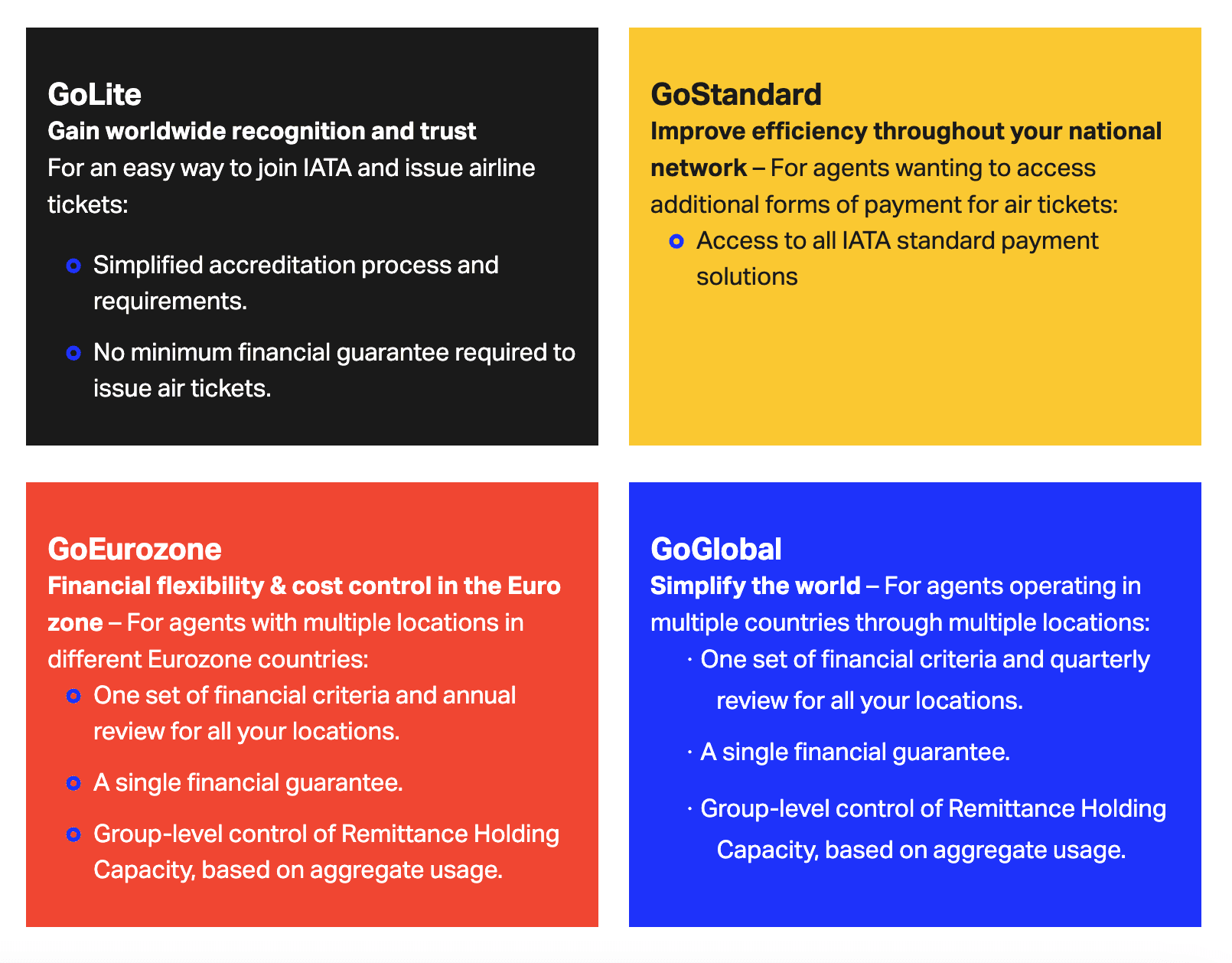
IATA doesn't take a one-size-fits-all approach. Over the years, they've introduced multiple accreditation models to cater to different agency needs. The two most common are the GoStandard Accreditation and the GoLite Accreditation.
1. GoStandard Accreditation
It is the traditional model, where your agency assumes full financial responsibility and provides a guarantee against ticketing volumes. You get direct access to BSP, can issue tickets in your own right, and are subject to ongoing audits and compliance checks. This model is best suited for established agencies with solid cash flow, strong governance, and aspirations of long-term scale.
2. GoLite Accreditation
This was created to reduce entry barriers. Here, IATA eliminates the requirement for a financial guarantee. But there's a catch: you must settle transactions via credit card only. This protects airlines from default but also restricts your flexibility in payment options. For small or mid-sized agencies testing the waters, GoLite can be attractive, but the lack of settlement flexibility can become a bottleneck as you scale.
3. GoEurozone and GoGlobal
These two are for TAs operating across geographies. These agreements consolidate compliance under a single umbrella but demand extreme operational discipline. The choice of model isn't just about ticking a box; it defines your settlement flexibility, your financial exposure, and your future room to maneuver.
Challenges in IATA Accreditation
Getting accredited isn't a stroll in the park. Agencies face hurdles that range from financial to operational to psychological.
1. Financial Barrier
Bank guarantees or insurance bonds freeze liquidity that could otherwise fuel growth. For agencies running on thin margins, this is a make-or-break challenge. Add in annual fees, compliance costs, and tech investments, and suddenly accreditation feels like an anchor, not a sail.
2. Rigorous Reporting
Operationally, the reporting discipline required by BSP trips up many first-timers. You need airtight mid-back-office systems that reconcile sales, refunds, ADM/ACM (Agency Debit/Credit Memos), and settlements on razor-sharp deadlines. Manual processes buckle under this load, and agencies that fail to automate end up drowning in reconciliations.
3. Reputational Issues
Then there's the trust factor. Airlines don't take chances with financially unstable agencies. If your financial statements show irregularities or your guarantees fall short, IATA won't hesitate to slam the brakes. This breeds frustration among agencies that underestimate how conservative IATA's risk appetite truly is.
4. Cultural Challenge
Lastly, there's the human side. Staff who are brilliant at selling travel often struggle with compliance-heavy processes. Retraining them to live under audit regimes and BSP discipline is a cultural shift, not just an operational tweak. Agencies that fail to prepare their teams often burn out under the new reality.
Mistakes Travel Agencies Make While Trying to Get IATA Accredited
Here's where agencies shoot themselves in the foot, repeatedly.
1. Underestimating the Financial Guarantee
Agencies assume it's a small token sum, only to realize it ties up tens of thousands of dollars. This catches them off guard, forces them to scramble for liquidity, and sometimes derails the entire process.
2. Treating Compliance as an Afterthought.
Agencies focus on the paperwork to get accredited but neglect to build the systems that will sustain compliance afterward. Passing the initial audit is one thing; surviving monthly BSP cycles is another. This “we'll fix it later” mindset almost always backfires.
3. Apply Too Early
Some agencies go for IATA accreditation way too early in their lifecycle. They chase accreditation as a status symbol before their volumes justify it. Instead of leveraging consolidators to build resilience, they sink into the quicksand of guarantees and fees without the revenue to offset them. It's vanity over viability, and it rarely ends well.
4. Failing to Prepare Staff for Compliance Rigor
Sales-driven teams often see BSP processes as red tape, leading to errors, missed deadlines, and penalties. Without a compliance-first mindset, accreditation becomes a burden rather than an enabler.
5. Confusing IATA Accreditation with Guaranteed Growth
The deadliest of all mistakes. It's a license, not a business model. If your strategy, client acquisition, and tech stack are weak, IATA accreditation won't save you. It might even accelerate your downfall by increasing your overhead without improving your topline.
IATA Accreditation Eligibility Checklist
Let's assume you've done your soul-searching and you're ready to take the plunge. What does IATA actually expect from you?
1. Documents, Permits, Certifications
They want to see that you are a legally established business with all the right licenses. Think of this as the hygiene factor: if you don't have it, don't even bother applying. Depending on your jurisdiction, this may involve-
- Travel agency registration
- Tourism ministry permits
- Tax certifications
2. Proof of Financial Stability
IATA will scrutinize your audited financial statements, assess your cash flow, and demand guarantees. If you're undercapitalized or juggling debts, your application will likely hit a wall. They don't care about your aspirations; they care about your ability to settle bills on time.
3. Professional Competence
At least one manager in your agency must demonstrate relevant industry experience and training. IATA isn't in the business of accrediting hobbyists. They want professionals who understand BSP processes, settlement risks, and ticketing compliance.
4. Right Infrastructure
This includes ticketing systems certified to interface with BSP, robust accounting processes, and data security measures. In today's climate, IATA also pays close attention to fraud prevention controls. If you don't have airtight processes, you're not just risking denial; you're risking operational disaster.
Step-by-Step Application Walkthrough
Now let's roll up our sleeves and walk through the process itself.
1. You Begin by Applying Through IATA's Customer Portal
The forms themselves aren't rocket science, but the supporting documentation can be a nightmare if you're unprepared. Expect to provide-
- Incorporation certificates
- Tax registrations
- Financial statements
- Bank references
- Insurance details
2. Next, IATA will Request Financial Guarantees
This is the part that often stings. Depending on your risk profile, they may ask for a bank guarantee or insurance bond covering a significant chunk of your projected sales. Agencies underestimate this all the time, only to choke later when cash is tied up unnecessarily.
3. Site Inspection
An IATA auditor will review your premises, staff qualifications, and systems. Don't treat this as a box-ticking exercise. They will probe into your BSP reporting capabilities, accounting systems, and operational controls. If you stumble here, your application stalls.
Assuming you pass, you'd be part of the IATA club, and you'll be issued your IATA numeric code and granted access to BSP. However, remember, accreditation is not a one-time achievement. It's an ongoing responsibility.
The Post-Accreditation Reality Check
After getting accredited, staying compliant is another beast altogether.
Every month, you must reconcile sales, submit reports, and settle payments through BSP on strict timelines. Slip up, and penalties kick in fast. Fail repeatedly, and you risk suspension. Airlines don't have patience for sloppy agencies.
Your finance team must get used to living under constant scrutiny. Audits can be announced or a surprise. Your staff must remain trained on compliance updates, especially as IATA adapts to NDC, one-order, and evolving settlement models. The bar keeps moving higher.
Alternatives Worth Considering
Not every agency needs to go down this path. In fact, for many, alternatives offer better ROI.
1. Host Agencies and Consolidators
For small agencies or startups, this is often the smarter move. Host agencies and consolidators allow you to access ticketing capabilities without bearing the financial burden of IATA accreditation. You piggyback on their accreditation, pay them a service fee or commission, and avoid tying up capital in guarantees.
2. Airline APIs, NDC Aggregators, or GDS Resellers
Some OTAs bypass IATA altogether by working with airline APIs, NDC aggregators, or GDS resellers. This model trades direct BSP access for agility and lower upfront compliance. If your focus is tech-driven leisure sales rather than corporate contracts, this can work.
At Iween, we often advise agencies to map their growth trajectory. If you're aiming for scale, building long-term credibility, and servicing corporates, IATA is worth the grind. If you're optimizing for lean operations, flexibility, or niche markets, alternatives can carry you far without the shackles. Check Iween’s suite of products for TA, OTA, and TMC:
The Tech Side of Accreditation Nobody Talks About
Let's get nerdy for a moment. Because the operational pain points of IATA accreditation often stem not from the paperwork but from the technology.
1. Your Mid-office and Back-office Systems Must Integrate Seamlessly with BSP
Manual reconciliation is a recipe for disaster. Agencies without proper automation end up spending days chasing mismatched records, duplicate PNRs, and settlement errors. The cost of that inefficiency far outweighs the prestige of accreditation.
2. Data Security is Another Minefield
BSP transactions involve sensitive financial data. If your systems aren't vault-secure, you're exposing yourself to fraud and cyber risks. Airlines don't care if you got hacked; they'll still demand settlement.
3. NDC Factor
IATA accreditation today doesn't automatically grant you smooth access to NDC content. You still need the right API connections, the right aggregator partnerships, and the right booking flows. Agencies that assume accreditation solves all content challenges are in for a rude shock.
This is why we hammer on travel agencies’ tech readiness before application. Accreditation without infrastructure is like giving a first-time driver the keys to a Ferrari. It's going to end badly.
Final Thoughts: Should You or Shouldn't You?
IATA accreditation is not a rite of passage. It's a strategic decision. At Iween, we've advised agencies to go for it and watched them scale beyond their wildest expectations. We've also advised agencies to avoid it, and they thrived using alternative models.
So, how do you decide? Strip the hype. Do the math. Look at your financial resilience, your operational discipline, your client base, and your long-term vision. Ask yourself if accreditation solves a real bottleneck or if it's simply a shiny badge.
If the answer is yes, then roll up your sleeves. Prepare for audits, guarantees, and never-ending compliance. Build the right tech backbone. Train your people. Embrace the rigor. Because accreditation will test every weak link in your agency.
If the answer is no, walk away unapologetically. There is no shame in running a lean, efficient, non-IATA agency that thrives on consolidator relationships or tech-driven distribution. The market has room for both models.
At the end of the day, the goal is not to collect acronyms but to build a sustainable, profitable, and resilient travel business. Accreditation is just one path to that destination. Whether you walk it or not, that's your call.

Nishant Choudhary
Content MarketerIn this article
1.What’s IATA Accreditation?
2.Why IATA Accreditation Even Matters
3.Accreditation Business Case
4.Types of IATA Accreditation
5.Challenges in IATA Accreditation
6.Mistakes TAs Make for IATA Accreditation
7.IATA Accreditation Eligibility Checklist
8.Step-by-Step Application Walkthrough
9.The Post-Accreditation Reality Check
10.Alternatives Worth Considering
11.The Tech Side of Accreditation Nobody Talks About
12.Final Thoughts